
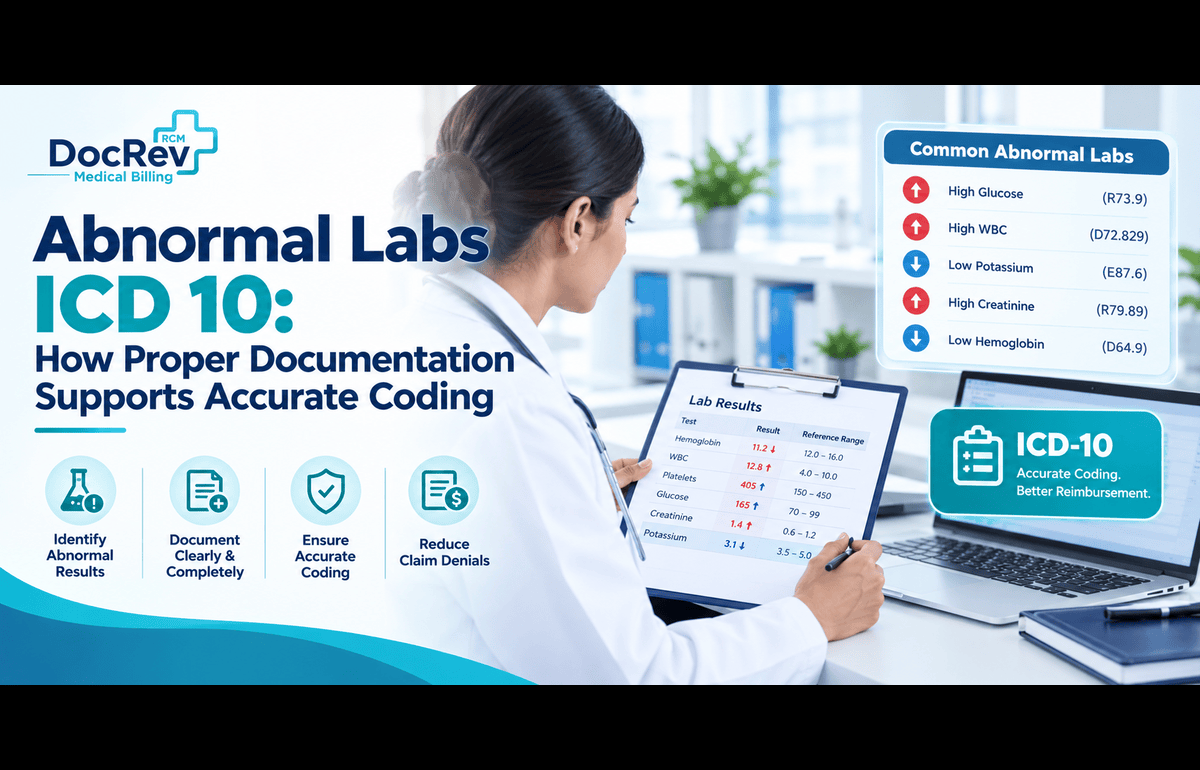
What Does Abnormal Labs ICD 10 Mean?
When people search for abnormal lab results ICD 10, they usually want one thing: the right code for a result that is out of range. The honest answer is that no single code covers every case. ICD-10-CM has a group of codes for abnormal findings, and it has many more codes for actual diagnoses. The right choice depends on what the provider wrote in the record.
Understanding Abnormal Laboratory Findings in ICD-10-CM
An abnormal laboratory finding is a test result that falls outside the lab's normal range. ICD-10-CM gives these findings a home in Chapter 18: R00–R99. The full chapter name is “Symptoms, signs and abnormal clinical and laboratory findings, not elsewhere classified.” In short, the chapter holds codes for things a provider finds but has not yet explained with a diagnosis. The key idea is simple. Abnormal laboratory findings ICD 10 CM codes describe a result. They do not describe a disease. When a provider names a disease, the disease code usually replaces the finding code.
Difference Between an Abnormal Result, a Sign or Symptom, and a Confirmed Diagnosis
These three terms sound alike, but they are not the same:
- Abnormal result: A number or finding from a test, such as a high glucose level.
- Sign or symptom: Something the provider sees or the patient reports, such as fatigue or swelling.
- Confirmed diagnosis: The provider names the condition, such as diabetes or anemia, and records it as a diagnosis.
A definitive diagnosis outranks the other two. Signs and symptoms coding is acceptable when the provider has not confirmed a related diagnosis. Once the provider does confirm one, you code the diagnosis. You do not add the routine signs and symptoms that come with it.
When an Abnormal Finding May Be Coded
An abnormal finding may be coded when the provider shows that it matters. Official guidelines say abnormal findings are not coded unless the provider indicates their clinical significance. The provider can show this in a few ways:
- Writing the finding in the assessment, such as “elevated liver enzymes”
- Ordering more tests to find the cause
- Starting treatment or a monitoring plan
- Stating that the result is clinically significant
A diagnostic interpretation from the provider also counts as the provider's voice. A flag from the lab system does not. Think of the flag as a nudge to look closer, not as permission to code.
Common ICD-10-CM Codes for Abnormal Lab Findings
People often search for one ICD 10 code for abnormal laboratory findings, but there is no master code. Searches for abnormal findings on laboratory tests ICD 10 lead to the same answer: each type of test has its own group. Below is a plain tour of the main groups. It shows examples, not a full list, because the Tabular List holds the final word on every code.
Abnormal Findings on Examination of Blood
Codes R70 to R79 cover abnormal findings on examination of blood, without a diagnosis. If you need an ICD 10 code for abnormal blood test results, start in this range. It includes odd red blood cell results (R71), high blood sugar (R73), and abnormal clotting tests (R79.1). Each group has more specific codes, so read down the list before you pick one.
Abnormal Blood Chemistry and Serum Enzyme Findings
Blood chemistry panels check things like minerals, proteins, and enzymes. When one of these results is abnormal and the provider gives no diagnosis, the finding may fit R74 for abnormal serum enzyme levels, such as raised liver enzymes. It may also fit R79 for other abnormal blood chemistry findings. Code R79.89 covers other specified findings, and R79.9 covers an unspecified finding.
Abnormal Findings on Urine Examination
Urine tests have their own group, R80 to R82. Examples include protein in the urine (R80.9), sugar in the urine (R81), bacteria in the urine (R82.71), and pus cells in the urine (R82.81). If the finding does not fit a named code, R82.90 covers unspecified abnormal findings in urine.
Abnormal Findings in Other Specimens and Body Fluids
The R83 to R89 range covers findings from other samples. These include spinal fluid (R83), breathing and chest samples (R84), digestive samples (R85), male and female genital samples (R86 and R87), other body fluids (R88), and other tissue and organ samples (R89). A provider may order tests on these samples after a symptom or a screening result.
How to Verify the Most Appropriate Code
The table below gives a compact view of common examples. It is a study aid, not a code book. Always confirm each code in the current ICD-10-CM resources.
| Code | Short description | Documentation note |
|---|---|---|
| R71.- | Abnormality of red blood cells | Provider documents an odd red cell result with no diagnosis |
| R73.- | Elevated blood glucose level | Provider documents high glucose with no diagnosis of diabetes. Check the extra characters. |
| R74.- | Abnormal serum enzyme levels | Provider documents a raised enzyme result and its significance |
| R79.1 | Abnormal coagulation profile | Provider documents an abnormal clotting test |
| R79.89 | Other specified abnormal findings of blood chemistry | Provider names the specific finding |
| R79.9 | Abnormal finding of blood chemistry, unspecified | Provider notes an abnormal chemistry result and gives no detail |
| R80.9 | Proteinuria, unspecified | Provider documents protein in the urine with no cause |
| R81 | Glycosuria | Provider documents sugar in the urine with no diagnosis |
| R82.90 | Unspecified abnormal findings in urine | Provider documents an abnormal urine result that fits no named code |
To verify a code, look up the main term in the Alphabetic Index, then confirm the code in the Tabular List. Read the notes under the code. If the provider has documented a diagnosis that explains the result, use the diagnosis code instead of the finding code. Choose the most specific option the note supports, because code specificity helps the payer understand the case.
Why Proper Documentation Matters for Accurate ICD-10 Coding
A coder works from the written record. If the record is thin, the code will be thin too. Strong provider documentation for ICD 10 coding gives the coder a clear base for every code assignment. It also gives the payer a clear reason to pay.
Establishing the Clinical Significance of Abnormal Results
The clinical significance of abnormal findings is the main question. A slightly high potassium in a healthy patient may mean nothing. The same number in a patient on a heart drug may need action. Only the provider can tell which case it is. When the note says the result matters, and says why, the coder has permission to report it. When the note says nothing, the coder has no way to know.
Connecting the Finding to the Provider's Assessment
A lab value sitting alone in the chart is not enough. The provider should link it to the assessment. A good note might read, "Hemoglobin low at 9.1. Likely blood loss. Start iron and repeat in four weeks." That one line shows the finding, the thought behind it, and the plan. The coder can now see that the result drove care. Without that link, the result is only data.
Supporting Diagnosis Specificity and Code Selection
Diagnosis specificity depends on detail. Compare "abnormal blood sugar" with "type 2 diabetes with hyperglycemia." The first leads to a finding code. The second leads to a full diagnosis code. More detail means a more exact code, and a more exact code means a stronger claim. Vague words push coders toward an unspecified diagnosis, which payers often question.
Identifying Incomplete or Conflicting Documentation
Sometimes the record disagrees with itself. The lab report says severe anemia, but the progress note says mild. Or the assessment names a condition that no test supports. These documentation gaps stop the coder from choosing a code with confidence. Spotting them early saves time, because a short question to the provider costs far less than a denied claim.
Essential Documentation Elements for Abnormal Lab Results
The abnormal lab documentation requirements are simple to state. The record should show what the result was, what the provider thinks it means, and what the provider did about it. Complete and accurate documentation covers all three. Here is what to look for in each part of the note.
Provider Assessment and Clinical Interpretation
The note should show the provider read the result and formed a view. Words such as "consistent with," "due to," "clinically significant," or "no action needed" all help. This is the diagnostic interpretation. It turns a number into a medical statement. A signed note that only pastes the lab report does not show interpretation.
Relevant Signs, Symptoms and Confirmed Diagnoses
The patient medical record should also list the signs and symptoms that go with the result. Fatigue and pale skin support a low hemoglobin. Frequent thirst supports a high glucose. If the provider confirms a diagnosis, the note should state it plainly. These clinical indicators tell the coder whether to report a symptom, a finding, or a diagnosis. They also show payers that the care made sense.
Treatment, Monitoring and Additional Diagnostic Workup
What the provider does next proves the result mattered. The note might show a new drug, a changed dose, a repeat test, an imaging order, or a referral. Even a plan to watch and retest counts, as long as the provider writes it down. These steps support medical necessity for both the visit and any extra tests.
Clarification When Documentation Is Insufficient
If the note leaves a question open, ask for provider clarification. A physician query should be short, neutral, and based on facts in the chart. It should not lead the provider toward a certain answer. For example, a coder may ask, "The lab shows a sodium of 128. Please document the clinical significance, if any." The provider can then confirm a diagnosis, state no significance, or explain the finding. Either answer helps, because it removes the guesswork.
Inpatient vs. Outpatient Coding for Abnormal Lab Findings
The abnormal lab results coding guidelines are not the same in every setting. The official ICD-10-CM guidelines treat hospital stays and clinic visits differently. A coder who mixes the two sets of rules will make mistakes, even with perfect knowledge of the codes.
Inpatient Abnormal-Finding Coding Considerations
For hospital inpatients, the guidelines say abnormal findings from labs, x-rays, and other tests are not coded or reported unless the provider shows they are clinically significant. The provider may show this by ordering more tests, starting treatment, or adding a diagnosis. If a result looks important but the note is silent, the guidelines say it is appropriate to ask the provider. Inpatient rules also allow some uncertain diagnoses, such as "probable" or "suspected," to be coded as if they were confirmed when they are documented at discharge. That differs from the outpatient approach.
Outpatient Diagnostic Testing and Interpreted Reports
Outpatient rules are stricter about uncertainty. Coders do not report diagnoses described as "probable," "suspected," or "rule out." They report the signs, symptoms, or abnormal findings that prompted the visit instead. For outpatient diagnostic tests that a physician has interpreted, and where the final report is available at the time of coding, the coder reports any confirmed or definitive diagnosis in that interpretation. Fast-paced sites, such as those that need urgent care rcm services, often see this scenario daily, because many patients arrive with symptoms and leave with only lab results and a plan.
Why the Care Setting Changes Coding Decisions
The two settings serve different goals. Hospital coding reflects a full stay with many tests and many providers. Outpatient coding reflects one visit and one reason for care. Because of this, lab result coding guidelines give different weight to uncertain findings in each setting. Always confirm the care setting and the date of service first, then apply the matching rules.
Common Abnormal Lab Coding Errors to Avoid
Most errors in medical coding for abnormal lab results come from speed, not from lack of skill. Five mistakes show up again and again. Knowing them helps you catch them early.
Coding Every Flagged Result Automatically
Lab systems flag many values with an "H" or an "L." Many of those flags carry no meaning for the patient. If a coder reports each one, the claim fills with diagnoses that the provider never addressed. Payers may see this as unsupported coding. Report a flagged result only when the provider's note supports it.
Assigning Unspecified Codes When a More Specific Code Applies
Unspecified codes have a place, but they are a last resort. If the note says "low potassium due to diuretic use," a general code ignores useful detail. Read the full record before you settle on an unspecified diagnosis. Often the detail is already there, just in a different part of the chart.
Coding an Unconfirmed Diagnosis Without Applicable Support
In an outpatient setting, a note that says "possible anemia" does not support an anemia code. The coder should report the abnormal finding or the sign that led to the visit. Reporting a diagnosis that the provider has not confirmed can cause an audit finding and an abnormal lab results claim denial.
Ignoring the Applicable Setting-Specific Guidelines
As shown above, inpatient and outpatient rules differ. A coder who applies the inpatient approach to a clinic visit may report a diagnosis that the outpatient guidelines do not allow. The reverse also causes problems. Keep both sets of rules at hand and check the setting every time.
Failing to Resolve Material Documentation Gaps
The last error is to guess. When a note leaves out a key detail, some coders pick the closest code and move on. This habit hides documentation gaps instead of fixing them. If the missing detail would change the code or the payment, ask for provider clarification before you submit the claim.
Practical Coding Examples and Documentation Scenarios
Real cases make the rules easier to see. The four examples below are simplified and use made-up patients. They show how the same type of lab result can lead to different coding choices. Always check the current code set and your payer rules before you apply them to a real claim.
An Abnormal Result Without a Documented Clinical Assessment
A patient has a routine visit. The lab report shows a low sodium level, flagged in red. The progress note covers the patient's cough and says nothing about the sodium. The coder has no provider statement about the result. In this case, the finding should not be coded on its own. The coder may send a physician query that asks whether the result has clinical significance.
A Documented Abnormal Finding Under Further Evaluation
A patient sees a provider for tiredness. The provider writes, "Elevated liver enzymes noted. Will repeat labs and order an ultrasound." The provider has not made a diagnosis, but the note shows the result mattered and led to more work. An abnormal finding code from the R74 group may fit here. The coder reports the finding and the symptom, then confirms the exact code in the Tabular List.
A Definitive Diagnosis Established After Diagnostic Testing
After repeat testing, the same patient gets a final report. The physician writes, "Iron deficiency anemia due to chronic blood loss." That is a definitive diagnosis. The coder now reports the diagnosis code and does not also report the earlier abnormal finding that the diagnosis explains. This is a good example of how coding conventions keep a claim clean. Practices that outsource family medicine billing services often see this pattern, since primary care providers order many follow-up labs.
A Case That May Require Provider Clarification
A hospital note says "low hemoglobin" in one place and "severe anemia, transfused two units" in another. The lab report shows a value that does not fit with severe anemia. These clinical indicators conflict. The coder should not choose one version alone. A short query asking the provider to confirm the diagnosis and its type will settle the case, and it protects the claim.
How Accurate Documentation Supports Medical Billing
Good notes do more than help coders. They shape the whole billing cycle. When coding and billing for abnormal findings starts from a clear record, every later step gets easier, from claim scrubbing to payment posting.
Better-Supported Diagnosis Coding
Clear notes lead to ICD-10-CM diagnosis codes that match what happened in the visit. The payer sees a diagnosis, a test that fits it, and a plan that follows. That chain of logic is what a reviewer wants to see. When one link is missing, the claim looks weak, even if the care was right.
Reducing Avoidable Coding Errors and Claim Rework
Missing detail causes rework. A claim goes out with a vague code, the payer rejects it, and the team must find the note, ask the provider, and resubmit. That cycle takes days or weeks. Strong clinical documentation improvement for coding cuts it down, because the answers are in the chart before the claim leaves. Many hospitals run a clinical documentation improvement (CDI) program for this reason, and clinics can use the same idea on a smaller scale. This is also the best way to prevent an abnormal lab results claim denial in the first place.
Supporting Medical Necessity and Payer Requirements
Payers decide whether a test was needed by checking the diagnosis on the claim. An abnormal result with a documented reason supports the test, the repeat test, and the follow-up visit. Abnormal test results medical billing depends on this link. Age matters too. Pediatric reference ranges differ from adult ranges, so clinics that need pediatric medical billing south jersey should make sure providers note when a result is abnormal for the child's age.
Improving Audit Readiness and Compliance
Auditors read the chart, not the lab flag. If the record shows the finding, the provider's view, and the action taken, the code is easy to defend. If it does not, the practice may face payment takebacks. A regular medical billing audit can find weak notes early. At DocRev RCM, our team reviews coding and denial trends so that small problems do not grow, and our managed accounts reach 99% first-pass claim acceptance.
A Practical Checklist for Coders and Billers
Use this list each time an abnormal lab result crosses your desk. It takes only a few minutes, and it keeps the process the same from claim to claim.
- Verify the care setting and date of service. Inpatient and outpatient rules differ, and the code set changes each October 1.
- Review the complete medical record. Read the provider's notes, orders, and final reports, not just the lab sheet.
- Identify the provider-documented finding or diagnosis. Code from the provider's words, not from your own reading of the number.
- Verify the code in the current ICD-10-CM resources. Look up the term in the Alphabetic Index, then confirm it in the Tabular List.
- Check applicable code sequencing and reporting instructions. Follow the notes under the code, including Excludes notes and any "code first" or "use additional code" prompts.
- Query the provider when clarification is appropriate. Keep the question short, neutral, and tied to facts in the chart.
If you follow these six steps every time, most documentation problems will show up before the claim is sent.
Frequently Asked Questions
What is the ICD-10 code for abnormal lab results?
There is no single code. The code depends on the type of test and the finding. Chapter 18 holds most of them, such as R79.89 for other specified abnormal blood chemistry findings and R82.90 for unspecified abnormal urine findings. If the provider documents a diagnosis that explains the result, report that diagnosis instead. Always confirm the final code in the current Tabular List.
Can abnormal lab results be coded without a confirmed diagnosis?
Yes, in many cases. If the provider documents the abnormal finding and shows it is clinically significant, a code from Chapter 18 may apply. The provider does not need to name a disease. What the coder cannot do is report a diagnosis that the provider never confirmed, or code a flagged value that the provider never mentioned.
Are abnormal laboratory findings coded differently for inpatient and outpatient services?
Yes. Inpatient guidelines say abnormal findings are not coded unless the provider shows clinical significance. They also allow some uncertain diagnoses to be coded at discharge. Outpatient guidelines do not allow "probable" or "suspected" diagnoses to be coded. Coders report the signs, symptoms, or findings instead.
When should a coder query the provider about abnormal lab findings?
A query is wise when the note leaves a gap that would change the code or payment. Common cases include a flagged result with no comment, a conflict between the lab report and the note, or a diagnosis that lacks support in the chart. Keep each physician query neutral and based on facts.
How does proper documentation help prevent coding errors?
Clear notes give the coder what they need to pick the right code the first time. They show the finding, the provider's view, and the plan. This lowers the need for guesses, cuts claim rework, and supports medical necessity if a payer asks for records.
Conclusion
Abnormal labs ICD 10 coding comes down to three things: clinical significance, clear documentation, and code verification. A lab flag alone never decides a code. The provider's note does. When the note shows what the result means and what the care team did about it, coders can choose the right code with confidence, and payers can see why the care was needed. The habits are simple. Know the setting. Read the whole chart. Code from the provider's words. Check the Alphabetic Index and the Tabular List. Ask a question when a gap would change the claim.
If your team is tired of lab-related denials and rework, we can help. DocRev RCM offers medical billing, denial management, and medical billing audit support, with fees starting from 3% of collections. Ask for a free RCM assessment by calling +1 814-554-5350 or writing to info@docrevrcm.com, and we will show you where your claims are losing revenue.